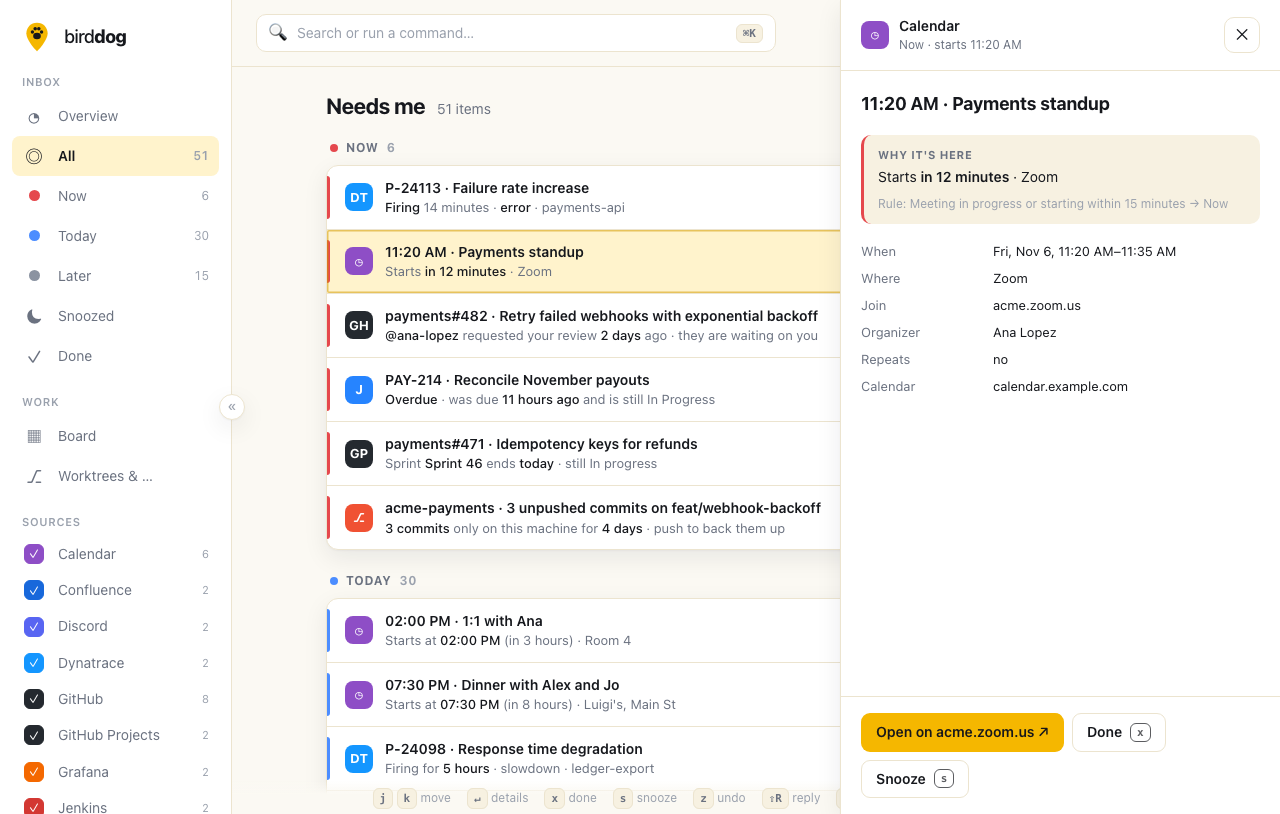
One list, with its reasoning out loud
Work in progress hides everywhere: a branch you forgot to push, a review someone is waiting on, a ticket due tomorrow, a meeting in ten minutes. Birddog puts it in one list, ranked into Now, Today and Later, and every item says why it's there.
@ana-lopez requested your review 2 days ago · they are waiting on youRule: review requested of you over a day ago → Now
🧭Explains itself
Every item names the rule that put it there. No scores, no machine learning: rules you can read.
🏠Local-first
Runs on your machine, listens on 127.0.0.1, keeps state in JSON files you can read. No telemetry, no account.
🔒Read-only by default
It never pushes, comments or moves tickets. Replies to Slack and Teams are opt-in, with a 5-second undo.
⌨️Keyboard-first
j/k to move, x done, s snooze, z undo, ⌘K for everything else.
✨Ask Fetch
Ask "what needs me now?" in plain words. Fetch runs on Claude with your own key, remembers what you tell it, and shows its boundaries.
🔌Talks to your AI tools
birddog mcp lets Claude Code, Claude Desktop or any MCP client ask what needs you and triage items.
Local gitGitHubGitLabJira CloudLinearAzure DevOpsGoogle, Outlook & iCloud calendarsSentryPagerDutySlackMicrosoft TeamsDiscordThunderbird mail & calendarsMicrosoft To DoGoogle TasksTodoistGmail & Outlook mail, noise filteredDynatraceGrafanaJenkinsGitHub ProjectsConfluence